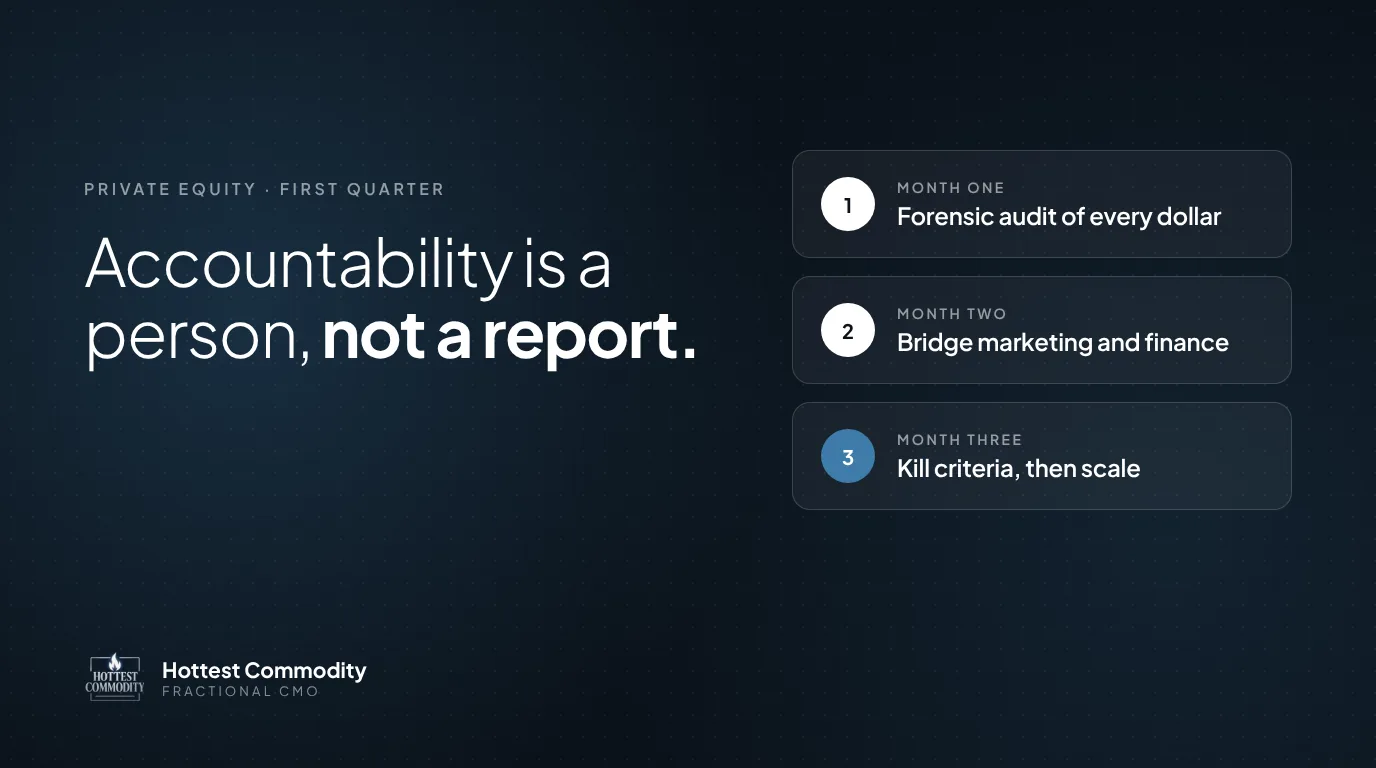
For a private equity partner, hiring a fractional CMO is not about keeping the marketing lights on. It is about fundamentally rewiring your growth engine to match the demands of your investors. The market does not care about your annual plan when you need quarterly results. You are not losing money because your ads are bad; you are losing money because you are guessing which ads are good.
Guessing is the most expensive line item in your budget, and it is the only one you cannot audit. When private equity steps in, the mandate shifts from vanity metrics to closed deals. Accountability is not a report; it is a person taking ownership of the revenue attribution bridge. Without that ownership, everyone pays for the gap.
Table of Contents
- Aligning the Value-Creation Plan
- The Forensic Diagnostic Audit
- Bridging Marketing and Finance
- Setting Kill Criteria for Quarterly Bets
- The Fallacy of the Bloated Agency Model
- Establishing Baseline Metrics and Scaling
- The Conclusion: Accountability Is a Person
- Frequently Asked Questions
Fractional CMO for Private Equity: Aligning the Value-Creation Plan
Private equity models run on strict timelines that demand immediate alignment with the overarching value-creation plan. A strategy without a name attached to it is just a wish. The first 90 days must be spent tearing down whatever legacy marketing exists and measuring it against the board's growth targets. If the marketing output does not directly support the exit multiple, it is actively detracting from it.
You cannot audit a guess, but you can audit a specific alignment mandate. The first step involves mapping every single active campaign to the core value drivers of the business. Any initiative lacking a clear, accountable bridge to revenue gets paused immediately. Direction is expensive, and unaligned motion is just noise.
Moving from founder-led chaos to private equity discipline requires a hard reset. You stop writing fiction in January and start looking at the actual numbers. If the leadership team cannot explain how a campaign directly feeds the pipeline, the campaign dies. This ruthless prioritization is the only way to build a compounding growth system.
The Forensic Diagnostic Audit
Before you can scale any lead generation machine, you need a forensic diagnostic audit of every dollar going out the door. The goal of the first quarter is not to immediately launch new creative or rebrand the company. The goal is to find the leaks in the current pipeline and plug them so you stop burning cash. You must know exactly what you are paying for and what it actually yields.
Bloated agency models and junior staff often inflate spend without delivering closed deals. When a firm steps in to deliver fractional CMO leadership, it looks for these exact inefficiencies. Accountability requires going through the ad accounts, the software stack, and the agency retainers line by line. You cut the dead weight first, and then you reallocate those funds into compounding growth systems.
Your software stack is likely full of overlapping tools that nobody actively manages. A proper audit strips away the excess technology that flatters your ego but fails to convert. You only keep the systems that provide clear visibility into which channels actually drive revenue. Everything else is just expensive digital clutter.
Bridging Marketing and Finance
If nobody owns the revenue attribution bridge between marketing and finance, everyone pays for the gap. You must build a reporting structure that speaks the language of private equity. That means focusing on customer acquisition cost, lifetime value, and marketing-originated pipeline. Vanity metrics that flatter but fail to convert into closed deals are immediately discarded.
Every Friday, the leadership team needs to see a dashboard that accurately reflects the week's bets. Without this visibility, scaling spend becomes a reckless gamble rather than a calculated investment. The finance department needs to trust the marketing data implicitly. When marketing and finance finally speak the same language, scaling the business becomes a calculated decision rather than a hopeful prayer.
Accountability is a person standing in front of the board explaining exactly how marketing dollars convert to pipeline flow. You cannot hide behind impressions, clicks, or engagement rates when the board wants to know about closed deals. The first quarter is when you establish the reporting cadence that gives investors confidence. You deliver the raw truth, even when the numbers are ugly.
Setting Kill Criteria for Quarterly Bets
The market only cares about your quarterly bets, so you must treat every campaign as a measured risk. Stop writing fiction at the start of the year and start setting kill criteria in September. Every campaign launched in the first quarter must have a predefined failure point where funding is pulled. This prevents emotional attachments to failing campaigns from draining the budget.
Kill criteria remove the guesswork from marketing management. When you establish exactly what failure looks like before you spend a dime, you protect the downside. This discipline is what separates senior-level marketing leadership from junior executors who just want to run more ads. You define the floor, you measure the results daily, and you cut the cord the moment a bet misses its target.
Setting a kill criterion is the ultimate form of financial accountability. It proves to the board that you are managing its money with extreme prejudice. If an ad set fails to hit its target cost per acquisition within seven days, you turn it off. There is no room for hope in a private equity hold period.
The Fallacy of the Bloated Agency Model
Private equity firms hate waste, yet many portfolio companies inherit a web of bloated agency retainers. These legacy relationships often prioritize output volume over actual pipeline flow. The first-quarter mandate involves auditing these external vendors to see who is actually driving revenue. If an agency cannot tie its work to closed deals, its retainer is terminated.
This is where a full-stack marketing execution model outpaces traditional outsourced relationships. Instead of paying a full-time executive salary while still outsourcing the execution, you get embedded senior oversight. You consolidate the vendor list, streamline the tech stack, and build an internal growth engine that actually scales. The focus shifts entirely from managing relationships to managing yield.
Agencies will often fight the implementation of strict kill criteria because it threatens their monthly billing. You must ignore their protests and enforce the new standards relentlessly. If they cannot deliver attributed revenue, they do not deserve a seat at the table. Your loyalty belongs to the value-creation plan, not to legacy service providers.
Establishing Baseline Metrics and Scaling
Once the leaks are plugged and the reporting is built, the focus shifts to creating a baseline for scaling. You need channels that actually drive revenue predictably month over month. This is not about launching a viral campaign; it is about establishing a boring, reliable machine that produces qualified pipeline. You test channels methodically, applying capital only when the unit economics make sense.
A true growth engine requires constant monitoring and relentless optimization. You do not set it and forget it. You watch the conversion rates at every stage of the funnel, identifying where prospects drop off and fixing those choke points. Over time, this system provides the board with the confidence needed to scale spend aggressively.
By the end of the third month, the guessing must stop entirely. The leadership team should have total visibility into which channels work and which ones are burning cash. The bridge between marketing and finance should be fully built, with every dollar accounted for. You transition from diagnostic auditing to aggressive, measured scaling.
The Conclusion: Accountability Is a Person
If you reach the end of the first quarter and you still cannot point to the specific person accountable for revenue attribution, you have failed. The foundation built during these 90 days dictates the success of the entire private equity hold period. You either establish rigorous financial discipline now, or you pay for the gap until the eventual exit. The choice is binary.
Your marketing budget is an investment vehicle, and it must be managed with absolute precision. A competent fractional CMO partner will force this discipline into your organization from day one. You stop paying for unaligned motion and start paying for directional velocity. Guessing ends the moment the first quarter begins. If you want that discipline in place before your next board meeting, start with the X-Ray.
Frequently Asked Questions
What Is the Primary Focus During the First 30 Days?
The absolute priority is the forensic diagnostic audit. You cannot build a reliable growth engine on top of a leaky foundation. The first month is dedicated to finding where the budget is bleeding and stopping the waste entirely.
How Does Reporting Change Under Senior Marketing Leadership?
Vanity metrics like impressions and click-through rates are immediately replaced by pipeline flow and revenue attribution. The board needs to see the exact return on every dollar spent. The reporting cadence shifts from monthly fluff pieces to weekly accountability reviews.
Why Are Kill Criteria So Important?
They prevent you from funding bad bets out of hope or emotional attachment. A kill criterion defines exactly when a campaign will be shut down if it fails to hit its performance floor. This strictly limits your downside risk while preserving capital for winning channels.
How Do You Align Marketing with the Value-Creation Plan?
You map every single marketing initiative directly to the board's growth targets and exit multiple. If a campaign does not have a clear, mathematical path to increasing enterprise value, it is scrapped. Every dollar spent must justify its existence through closed deals.